
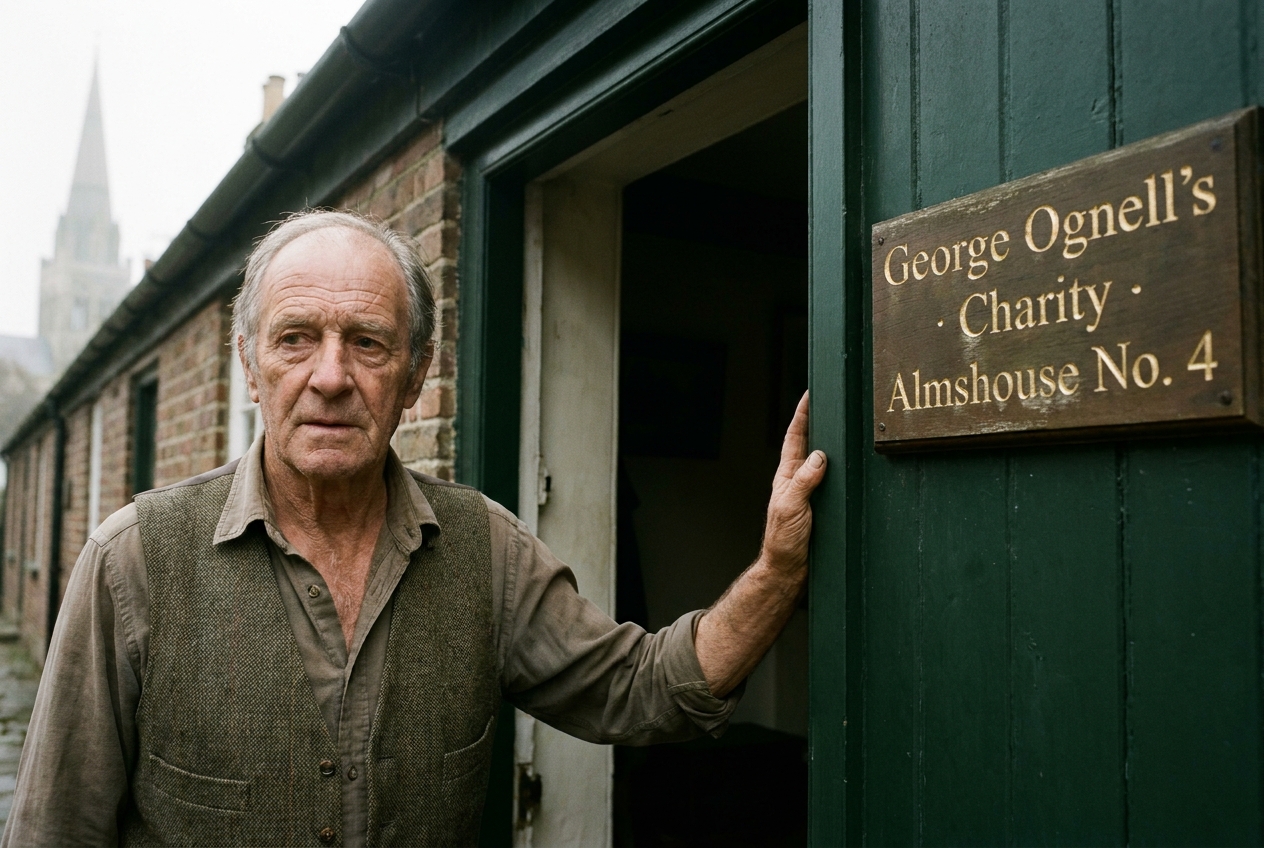
Derek was on the housing list with us for fourteen months. That is a long time to wait, and we are not proud of it. The trouble is the obvious one: we have only four almshouses, and a tenancy is for life. The previous tenant of what is now Derek’s cottage, a quiet man called Ernest who had been with us since 2009, died in early September 2025. The next call we made, after the funeral, was to Derek.
Derek is 74. He grew up in Cocking, four miles south of here, in a tied cottage on the same estate his father had worked on for forty-one years. When his wife Margery died in 2021, the tied tenancy lapsed (the estate were generous about it, but the cottage was needed), and Derek moved into a small rented flat in Cocking, on a six-month assured shorthold tenancy that was twice renewed and once not. We met him in the summer of 2024, when his Wassail Fund application for a winter coat came in. He did not need a coat. He needed somewhere to live.
The application form for an almshouse, in our case, is a single sheet of paper that asks the applicant to write a short letter about themselves and their circumstances. Derek wrote his on the back of a parish-magazine envelope. We have it in the file.
“I do not need very much, in the way of room or fixtures. I would like to be near the post office, the doctor and the church, in roughly that order.” — Derek, in his application letter, 18 July 2024
How the decision was made
The trustees met three times to talk about the placement, after Ernest’s death and the proper period of grace. Almshouse trustees have to be careful, in these moments, about the difference between need and fit. Derek met every criterion in our Scheme: he had lived in West Sussex for more than ten years (in his case, for all of them), he was over 60, he was in housing need, and he was within the area of benefit. He had also, by the time we made the decision, become known to several of us through the Tuesday garden mornings, where he had been turning up for about six months as a Wassail Fund recipient and, increasingly, as a useful pair of hands.
The two formal interviews were conducted by Alain Mardle (safeguarding) and John Travers (treasurer). The chair’s home visit, in a rented flat above the bakery in Cocking, was an honest hour.
Derek moved in on Tuesday 14 October. The kettle was on. Eileen had baked.
What he brought with him
Almshouses are small. The standard cottage at Ognell’s Row has a kitchen of about three metres by three, a sitting room slightly larger, a single bedroom upstairs and a small bathroom off it. There is no room for a complete household’s worth of furniture. Derek brought: one armchair (Margery’s), one chest of drawers, his books, four pictures, his late father’s longcase clock (which had to come in three pieces), and a substantial collection of dahlia tubers.
The dahlias took us by surprise. Derek had been quiet about them in the interviews. Within ten days of his arrival he had asked — politely, in person, with a printed plan of the south bed of the garden — whether he might take responsibility for the dahlias and the sweet peas. The Tuesday team agreed with what I can only describe as relief; the previous custodian of the south bed had retired in 2023 and we had been muddling through with brassicas.
What life is like, six weeks in
Quiet. Derek walks into Knockhundred Row for his newspaper at twenty past seven each morning. He has coffee with Eileen on Wednesday afternoons, which is a development of which we approve. He has been to evensong twice. He still goes back to Cocking on Saturday mornings, on the bus, to see one of his neighbours who is too frail to come to him. We pay the bus fare from the Wassail Fund.
The dahlias will not flower until next August. Derek has staked them, in the smaller bed at the south of the garden, and has covered them with three inches of leaf-mould. Richard, who knows about these things, says they will be exceptional.
On the waiting list
We currently have nine names on the almshouse waiting list. That number is too high. We are honest with every applicant about how rarely we can move people through the list (a death and a bereavement; nothing else releases an almshouse). We refer applicants, with their consent, to the South Downs Almshouse Network, who maintain a wider list across Sussex, and to housing associations and social-housing referrals where appropriate. We hold a face-to-face meeting with every applicant within six weeks of receiving their letter, even when we have no prospect of housing them.
If you know an older neighbour in West Sussex who might be in need of an almshouse, please write to us. We will tell you honestly whether we are likely to be able to help.
This piece was read in full by Derek before publication, and printed only with his approval. Photograph by Mrs Judy Fowler, with consent.