
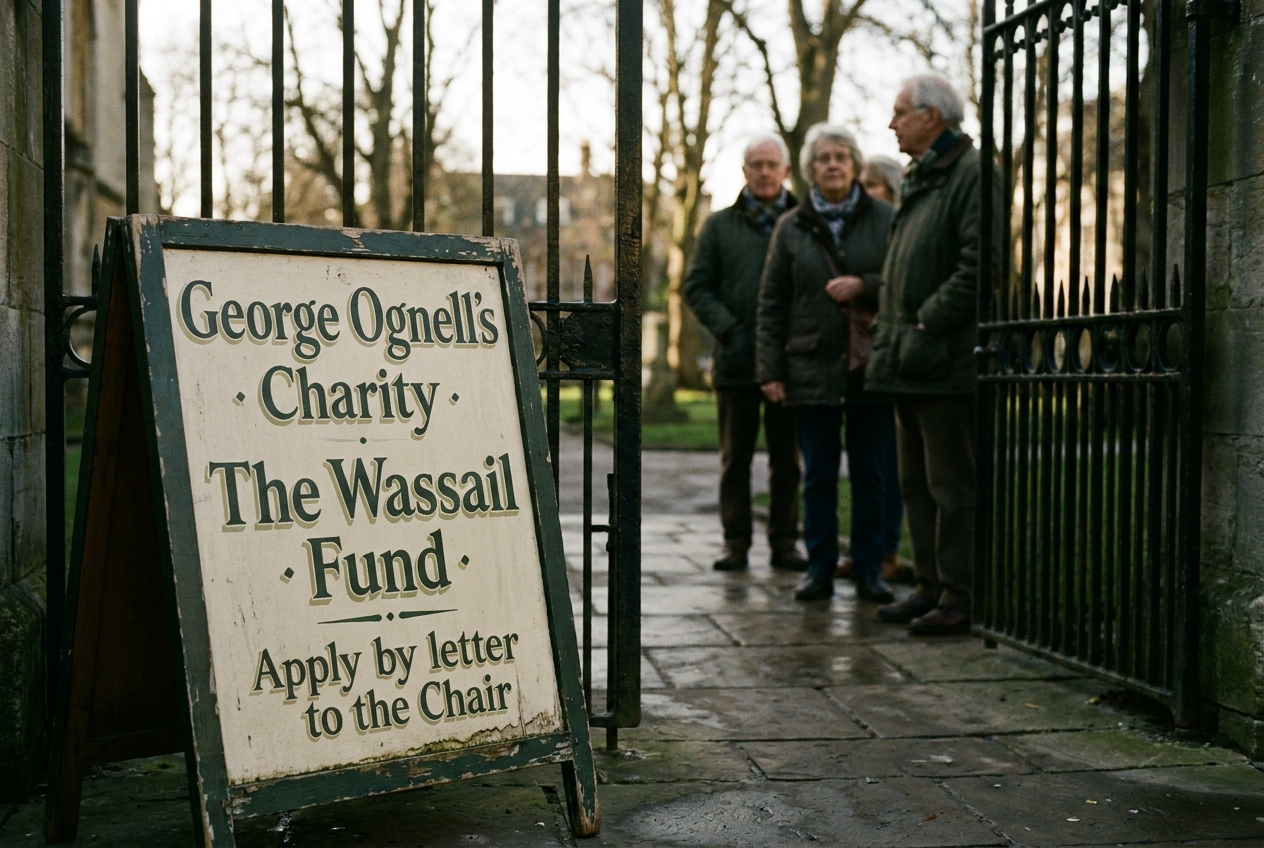
The Wassail Fund is the smallest of our four undertakings, but the one that touches the most lives. It was established in 2018, when the residual endowment of George Ognell’s Educational Foundation was transferred into the almshouse charity, and it has paid out somewhere between £8,000 and £12,000 a year ever since. This is a note on what the first quarter of 2026 looked like.
Between 4 January and 29 February we received 38 applications, made 36 decisions, paid out 31 grants, and politely declined five (three of which were outside our area of benefit, and two of which we did not have the funds to meet). The total disbursed was £4,180, against a quarterly budget of £3,500 set at the November trustees’ meeting. The £680 over-spend will be carried as a first call on the spring quarter.
“We do not ask for receipts of a personal kind. We never pay cash. We never make the recipient feel like an applicant.” — John Travers, treasurer, on the Wassail Fund discipline
How the decisions were made
Every Wassail Fund application is reviewed by two trustees. One of those two is always John Travers, our treasurer, who chairs the grants meeting. The second trustee is rotated: in this quarter it was variously Richard Watts, Alain Mardle, Glyn Upjohn or Doon Muir. The chair (myself) reviews each decision after the meeting and signs the payment slip, but does not take part in the decision itself; this is by design, to keep the chair available for second-opinion appeals.
We make decisions on the second Wednesday of every month, in the parish room at Easebourne, with the door open and the kettle on. Applications received less than three working days before the meeting are held over to the next month, except where there is a clear time-sensitive need (a heating bill due before the next meeting, for example), in which case the chair and the treasurer make an interim decision by email.
The typical decision time, from receipt of the letter or telephone message to the payment hitting the supplier’s account, is six working days. The fastest decision this quarter was three working days; the slowest was eleven, in a case where we needed to wait for a quote from a chimney sweep.
What the money went on
With the recipients’ permission, here is the breakdown of where the £4,180 went. We have grouped the grants by purpose; the recipients are named only as “a neighbour in” their parish.
- £1,420 across 11 grants — heating bills. The coldest December in seven years pushed several older neighbours into a position where the oil tank needed topping up before the next pension day. We paid the supplier directly in every case.
- £640 across 4 grants — replacement spectacles. Three pairs of reading glasses; one pair of distance glasses, after a fall and a broken frame.
- £540 across 3 grants — hearing aids and the fitting. Two NHS-prescribed; one private, where the NHS waiting list in West Sussex would have been six months and a phonecall to the GP made plain that this was not acceptable for the neighbour in question.
- £480 across 4 grants — chimney sweeping and minor flue repairs. The Wassail Fund will not pay for installations, but will pay for safety repairs on existing flues.
- £420 across 3 grants — winter coats and footwear, sourced from the Midhurst charity shop on Knockhundred Row and from Marks & Spencer in Chichester.
- £280 across 3 grants — taxis to and from hospital appointments at St Richard’s, Chichester. The Wassail Fund does not generally pay for ongoing transport, but will cover individual journeys where the alternative is to miss the appointment.
- £250 across 2 grants — small grab-rails and a stairlift assessment.
- £150 across 1 grant — a replacement hearing-aid battery contract for the year.
The five we declined
We declined three applications that fell outside our area of benefit. In each case we replied within five working days, by hand, on charity letterhead, with a list of two or three alternative funds that might be able to help. We declined two applications within our area of benefit because we did not have the funds to meet them and could not, in conscience, prioritise them above the heating-bill applications we had already received.
One of those two has since been met by a sister charity in Petworth, to whom we passed the referral with the applicant’s consent. The other we have held over to the spring quarter, and we hope to be able to meet it then.
Who the grant-makers were
The £4,180 came from three sources. £2,800 from the Wassail Fund income (the dividend stream from the merged endowment); £900 from a designated grant from Sussex Community Foundation, restricted to fuel poverty; £480 from the residue of the winter appeal carried over from December. The accounts will reflect this split when the audited figures are filed at year-end.
How to apply
The Wassail Fund is open to older neighbours (60+) within the area of benefit. Apply by letter to the chair, by telephone on a Tuesday-to-Thursday between 10.00 and 15.00, or in person at the Tuesday garden mornings. We do not require a household-income test; we ask only one question, which is whether you could meet the need without our help. The form is on the resources page, but a letter in your own words is just as welcome.
Mrs Judy Fowler has been Chair of the trustees since 2019. She writes the quarterly dispatches herself before they are typed up.