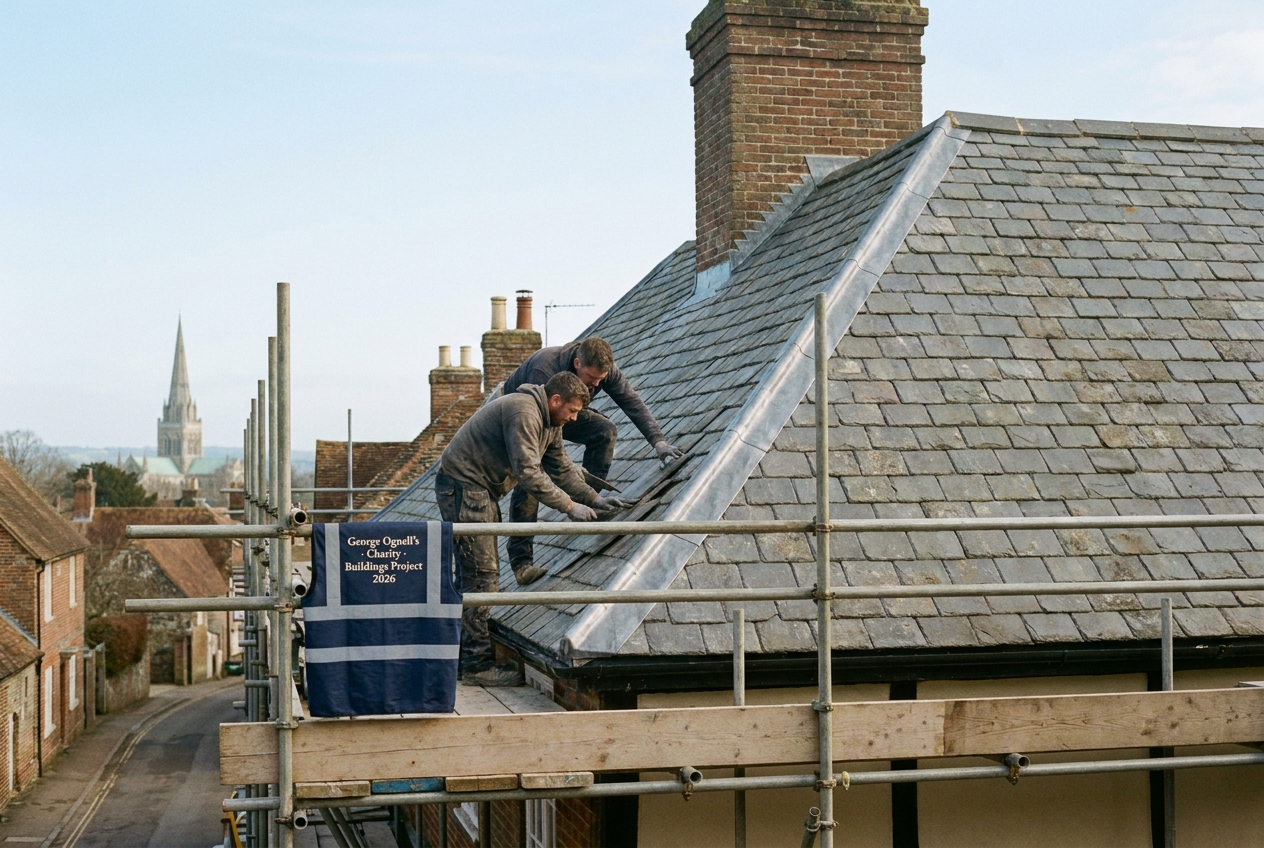
The slate roof of Ognell’s Row was last fully re-laid in the spring of 2008, in the long aftermath of the wettest winter the trustees of that decade had on record. The job was done by a Petworth slater called Peter Hammond, who passed his apprenticeship to his son Daniel in 2017, and it is Daniel Hammond and his small team who came back this March to redo the eastern slope.
We waited a long time for this work. Slate is patient material: a well-laid roof should give you sixty years, sometimes longer, and the eastern slope was only eighteen years on from its last lift. But the eastern slope is the one that takes the prevailing weather off the Downs, and the one that has lost the most slates to gales in the past three winters — two in November 2023, four in late January 2024, six (in a single Saturday night) in February 2025. We had been patching since 2022, and the patching had been getting more frequent. Daniel said the same to us in November: that we were spending more in scaffold call-outs than we would on a lift, and that the time had come.
“An almshouse is not a building. It is a promise that has been written down. The roof is the part of the promise that you can see, until it is gone, and then everyone can see the absence of it.” — Daniel Hammond, slater, Petworth
What the job involved
The eastern slope of the row is twenty-eight metres long and four-and-a-half metres wide on the slope. We took down all the existing slate (Welsh, Penrhyn, blue-grey, recovered from the 2008 lift and the original 1786 build — the slates themselves are mostly older than living memory), saved every slate that was sound, replaced the timber battens, re-laid felt of a heavier specification than the 2008 job, and re-slated.
We lost about a fifth of the slate to breakage in the lift. The rest went back, supplemented with reclaimed Welsh slate that Daniel had been collecting for two years against this job. The ridge tiles were re-bedded in lime mortar (the previous job had used cement, which we have come to regret — cement is too brittle for a building that moves with the seasons). The lead apron at the chimney stack was replaced.
The team were on site from 18 February to 21 March 2026, working a five-day week, weather permitting. The residents were not asked to move out. The scaffolding was up for five and a half weeks. The street was reduced to one lane for nine working days at the start and the end.
What it cost
The total cost of the work, including scaffold, materials, labour, lime mortar, lead, VAT, and the small extra for re-laying a section of valley flashing that we had not budgeted for, came to £23,840.
This is the largest single capital project the charity has undertaken in twenty years, and it was funded as follows:
- £14,000 — a grant from the Burrell Trust, a regional foundation that supports buildings work on Sussex almshouses. We applied in November 2024 and were awarded in March 2025.
- £3,500 — an interest-free loan from the South Downs Almshouse Network, to be repaid over four years.
- £6,318 — raised in our winter Wassail appeal, from 188 named individual donors. The smallest gift in this total was £2; the largest was £500. The appeal letter went out on 6 December 2025 and closed on 14 February 2026.
- £22 — from the parish-room collection plate at the carol service.
The accounts will record a small overspend of £262 against this total, which the trustees agreed at the February meeting would come from the buildings reserve. We will not be drawing on the Wassail Fund grant pot.
Why we waited
For a charity of our size, a roof lift is a generational decision. The whole-year income, in most years, is less than the cost of this job. We have one of these to do every twenty-or-so years on the eastern slope, and one every sixty on the western (the western slope is sheltered, and the 2008 lift will outlast this generation of trustees).
We waited until the patching was costing us money, until the Burrell Trust grant cycle came round, and until the Wassail Fund appeal could be timed against the trust’s award. We waited because the residents asked us not to start the work in the worst of the winter; we waited because we did not want to be doing it in the same season as the Spring Supper.
And we waited because, frankly, a roof lift is an unsettling thing to live underneath, and we wanted the residents to be ready. We invited each resident to talk to Daniel before the scaffolding went up. We agreed to take Saturdays off entirely. We agreed that the team would knock on each door at the start of the day and at the end of it.
What it looks like now
The eastern slope is darker than it was, because of the higher proportion of reclaimed Welsh slate in the new lift. The line of the ridge is straighter than it was. The chimney stack is no longer leaking. The third cottage is no longer the recipient of a small wet patch above the wardrobe in the back bedroom, which Eileen had been polite about for nine months.
The 1786 datestone, in the lintel of the third cottage, was carefully protected through the scaffold lift, and is back where it belongs. The building looks, from across Knockhundred Row, exactly as it has looked for two hundred and forty years.
Thanks
To Daniel Hammond and his team. To the Burrell Trust. To the South Downs Almshouse Network. To the 188 named donors of the winter appeal. To Eileen, Margaret, Pauline and Derek for putting up with us. To the chair, who answered all the letters herself.
If you would like to support the buildings reserve for the next job — almost certainly the chimney pots, in about seven years’ time — the donations page is here.
Richard Watts has been buildings trustee since 2014. He is a retired chartered surveyor who has lived in Midhurst all his working life.